Cotswold Wildlife Park Celebrates New Dads on Father's Day
Cotswold Wildlife Park is celebrating Father's Day by shining a spotlight on some of its newest animal dads and their adorable offspring
From one of the world's rarest large mammals to some of Africa's smallest carnivores, recent arrivals across the Park are helping secure the future of several important species as part of the European Breeding Programme.
Meet the newest dads at Cotswold Wildlife Park
Male Bactrian Camel Louis is one of the Park's newest fathers. His latest calf, Klaus, is making his public debut in time for Father's Day and ahead of World Camel Day on 22 June. Births of this Critically Endangered species remain rare in UK zoological collections, with only three other collections successfully breeding Bactrian Camels during the past 12 months.
Chris Kibbey, Assistant Animal Manager at Cotswold Wildlife Park & Gardens, said:
"Since arriving at Cotswold Wildlife Park, Louis has sired eight calves, helping to grow the next generation and secure the future of these remarkable animals. While camel fathers leave most of the day-to-day parenting to the mums, Louis has made an undeniable contribution to our herd, and his legacy can be seen across the paddock."
Camels have one of the longest gestation periods of any land mammal, lasting between 360 and 440 days. Newborn calves can stand shortly after birth and are usually walking within hours. Visitors can now see Klaus exploring the large paddock alongside the rest of the herd.
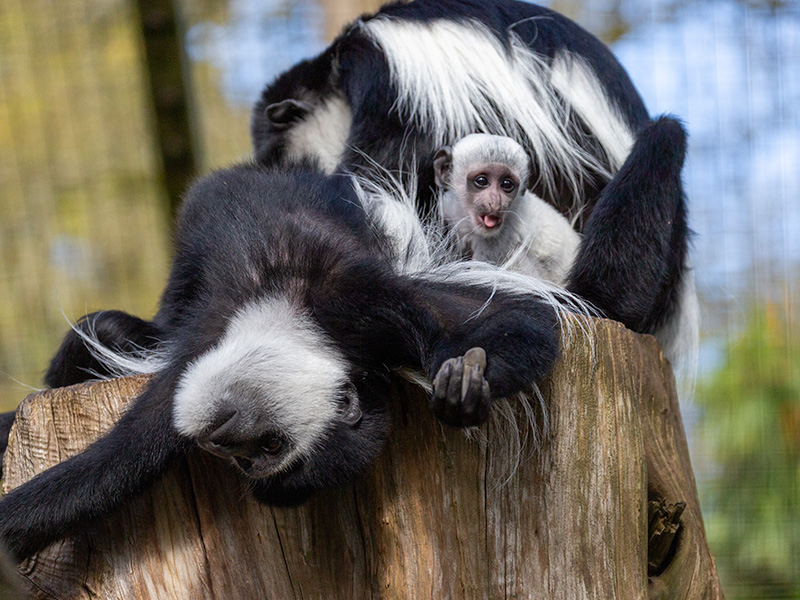
Elsewhere in the Park, Black-and-white Colobus male Tallus has recently fathered a new youngster named Dubu. Born to experienced mum Lexi, Dubu arrived weighing just 400 grams and, like all Colobus infants, was born with completely white fur which helps other troop members keep track of the youngster.
Natalie Horner, Section Head of Primates, Small Mammals and Birds, said:
"We are very happy to welcome a new baby Colobus to our troop here at the Park. Dubu, which means 'bear' in Swahili, was born to experienced mum Lexi. Lexi is wonderfully doting, ensuring her baby has everything he needs. Baby Colobus are born covered in completely white fur, this is to help contrast with the black fur of the adults. This makes it easier for the whole troop to keep an eye on them, often passing the baby around to help carry and care for them. It doesn't take long for their colouration to start to darken though, with Dubu's colouration change already beginning. He's growing in confidence every day, becoming very playful with his older siblings. He's also had his first tastes of solid food."
The Park's primate team has also been documenting Dubu's development from birth, creating a unique photographic and video diary that offers a rare insight into the early life of a newborn Colobus Monkey.
Natalie added:
"We've also recently welcomed another baby into our group of Coppery Titi Monkeys. Probably one of the sweetest monkeys around, you can often find the new addition sat in the middle of the group with all their tails entwined as part of their strong family connection."
In the Walled Garden, Yellow Mongoose father Chip has recently welcomed twins. Only two other zoological collections in the UK have successfully bred Yellow Mongooses this year.
Senior Keeper Hayley commented:
"Chip has been a wonderful father to his new twins. He's been a really attentive dad. At every feed, he always makes sure mum Nutmeg and the babies have food before eating anything himself. He also keeps a really close eye on the little ones while they explore the enclosure."
Visitors can also meet the Park's newest Dwarf Mongoose arrival. As Africa's smallest mongoose species, these tiny omnivores are among the continent's most fascinating small mammals and can be seen opposite Little Africa.
Protecting wildlife beyond the Park
Cotswold Wildlife Park has proudly supported the Wild Camel Protection Foundation since its inception and was the first zoological collection to do so. The charity works to protect the critically endangered wild Bactrian Camel and its fragile desert habitat in China and Mongolia.
Over the years, the Park has donated more than £20,000 to the charity and continues to support its important conservation work.
> Find out more about Cotswold Wildlife Park
Explore Gloucestershire
18 June 2026
New Colobus Monkey baby Dubu with mum Lexi. Photo credit: Philip Joyce.
For further information.
OTHER NEWS